Your car's electrical system runs on a handful of parts that all have to work together. The battery stores power, the alternator keeps that battery charged while the engine runs, and the starter uses battery power to get the engine turning over in the first place. Wrapped around all of that is a web of wiring, connectors, and grounds that carry power to everything from your headlights to your radio to your power windows. When one part of this chain gets weak, corroded, or just quits, the symptoms do not always point straight at the cause. A radio that cuts out one day and headlights that dim the next can both trace back to the same bad ground connection, even though they look like two separate problems.
Signs of an Electrical Problem
- Car clicks but won't crank
- Dashboard lights flicker or dim when you use the A/C or headlights
- Battery keeps dying even after a jump
- Power windows or locks work slow or not at all
- Random warning lights come on for no clear reason
- Interior lights or radio cut out while driving
At NICAR PRECISION AUTO REPAIR in Charlotte, we start with testing, not guessing. That means checking battery voltage and load to see if it can actually hold a charge under real demand, then testing the alternator's output to make sure it is putting out the right voltage while the engine runs. We also check the starter's draw, since a starter pulling too much current is often the reason a car cranks slow or not at all. None of this gets diagnosed by looking under the hood and guessing. It gets tested with the right equipment so we know which part is actually failing before we touch anything.
Grounds and connections get checked too, and this step matters more than people expect. A loose or corroded ground wire can cause problems that look exactly like a failing part, when really the part is fine and the connection just is not carrying power the way it should. This is a common reason people replace a part and the problem comes right back. For more complex issues, we bring in a scan tool to pull codes and trace circuits. That helps us narrow down where in the wiring the actual fault lives, instead of chasing symptoms around the car one guess at a time.
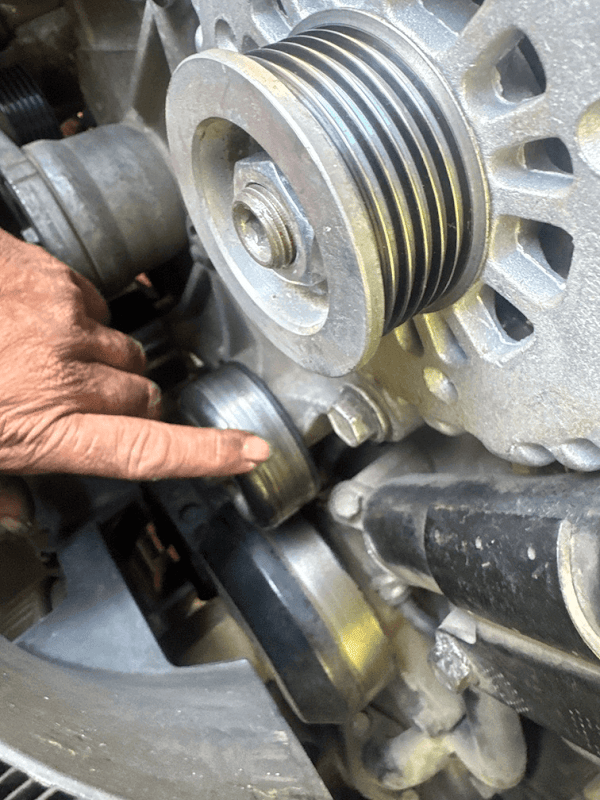
Once we find the cause, the fix itself can go a lot of different directions. Sometimes it is as simple as cleaning a corroded terminal or swapping in a new battery. Other times the alternator or starter has actually failed and needs to be replaced. And sometimes the problem is a wiring issue that has to be traced back to one specific connector or splice buried somewhere in the harness. The repair depends entirely on what the testing turns up, which is why we do not skip that step even when a problem seems obvious at first glance.
Electrical repairs usually come with a round of testing after the fix too. Once a part is replaced or a wire is repaired, we check the charging system's output again to confirm it is putting out the correct voltage. This matters because an undercharging or overcharging alternator will slowly wear down a brand new battery, and we would rather catch that now than have the same symptom show up again in a few weeks. Confirming the fix held is part of the job, not an extra step tacked on at the end.
What changes the size of the job is how deep the problem actually goes. A dead battery or a corroded terminal is usually a quick, contained fix. A wiring issue buried somewhere hard to access, or one that touches multiple systems at once, takes more time to trace back to its source and repair properly. Intermittent problems are their own category. The kind that only show up sometimes, like a stall that only happens once a week, usually takes more diagnostic time overall, since the issue has to actually be happening, or close to it, for us to catch it and pin down the cause.
If your car is showing electrical symptoms, pay attention to when it happens before you bring it in. Does it only act up when it's raining, when you hit a bump, or after the car has sat overnight without being driven. Notice which lights, gauges, or systems are affected when it happens, and whether it is the same every time or different. That kind of detail does not replace testing, but it gives us a starting point. It often points us toward the right circuit faster once we start checking voltage, grounds, and connections ourselves.
What to Tell Us When You Call
- Year, make, and model of your car
- What the car does, like clicks but won't start, or lights flicker
- When it happens, like only in rain or only after sitting overnight
- Any recent work done on the battery or electrical system